CSS :first-child-Pseudoklasse
Die CSS :first-child-Pseudoklasse wählt das Element aus, wenn es das erste Kind unter anderen Elementen ist.
Der Selektor :first-of-type kann verwendet werden, wenn der Benutzer den Stil auf das erste Absatz-Element anwenden möchte. Der :first-child-Selektor ist dem :first-of-type-Selektor zwar ähnlich, es gibt jedoch einen Unterschied: Sie erfüllen unterschiedliche Bedingungen. :first-child wählt ein Element nur dann aus, wenn es das erste Kind seines Elternelements ist, während :first-of-type das erste Element eines bestimmten Typs unter seinen Geschwisterelementen auswählt.
Version
Syntax
CSS :first-child Syntaxbeispiel
:first-child {
  css declarations;
}
Beispiel für die :first-child-Pseudoklasse mit dem <p>-Tag:
CSS :first-child Codebeispiel
<!DOCTYPE html>
<html>
  <head>
    <title>Title of the document</title>
    <style>
      p:first-child {
        background-color: #1c87c9;
        color: #fff;
      }
    </style>
  </head>
  <body>
    <p>Lorem ipsum is simply dummy text...</p>
    <h2>First-child selector example</h2>
    <p>Lorem Ipsum is simply dummy text...</p>
  </body>
</html>Beispiel für die :first-child-Pseudoklasse mit dem <li>-Tag:
CSS :first-child weiteres Codebeispiel
<!DOCTYPE html>
<html>
  <head>
    <title>Title of the document</title>
    <style>
      li:first-child {
        background: #8ebf42;
      }
    </style>
  </head>
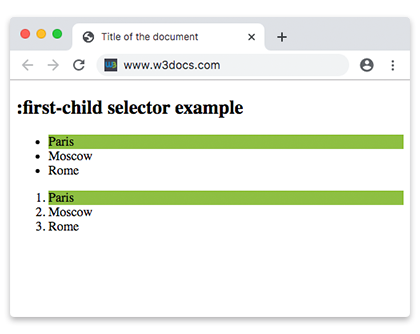
  <body>
    <h2>:first-child selector example</h2>
    <ul>
      <li>Paris</li>
      <li>Moscow</li>
      <li>Rome</li>
    </ul>
    <ol>
      <li>Paris</li>
      <li>Moscow</li>
      <li>Rome</li>
    </ol>
  </body>
</html>Beispiel für die :first-child-Pseudoklasse mit dem <ol>-Tag:
Beispiel für den :first-child-Selektor mit dem HTML ol-Tag
<!DOCTYPE html>
<html>
  <head>
    <title>Title of the document</title>
    <style>
      ol:first-child {
        background: #8ebf42;
      }
    </style>
  </head>
  <body>
    <ol>
      <li>London</li>
      <li>Paris</li>
      <li>Rome</li>
    </ol>
    <ol>
      <li>London</li>
      <li>Paris</li>
      <li>Rome</li>
    </ol>
  </body>
</html>Beispiel für die :first-child-Pseudoklasse mit dem <em>-Tag:
Beispiel für den :first-child-Selektor mit dem HTML em-Tag
<!DOCTYPE html>
<html>
  <head>
    <title>Title of the document</title>
    <style>
      p em:first-child {
        background: #82b534;
      }
    </style>
  </head>
  <body>
    <h2>:first-child selector example</h2>
    <article>
      <p>Here is a <em>some</em> text. This is a <em>example</em>.</p>
      <p>Here is a <em>some</em> text. This is a <em>example</em>.</p>
      <p>Here is a <em>some</em> text. This is a <em>example</em>.</p>
    </article>
  </body>
</html>Beispiel für die :first-child-Pseudoklasse mit dem <ul>-Tag:
Beispiel für den :first-child-Selektor mit dem HTML ul-Tag
<!DOCTYPE html>
<html>
  <head>
    <title>Title of the document</title>
    <style>
      ul li {
        color: blue;
      }
      ul li:first-child {
        color: #8ebf42;
        font-weight: bold;
      }
    </style>
  </head>
  <body>
    <h2>:first-child selector example</h2>
    <ul>
      <li>List Item 1</li>
      <li>List Item 2</li>
      <li>
        List Item 3
        <ul>
          <li>List Item 3.1</li>
          <li>List Item 3.2</li>
          <li>List Item 3.3</li>
        </ul>
      </li>
    </ul>
  </body>
</html>Praxis
Was stellt die :first-child-Pseudoklasse in CSS dar?