CSS isolation-Eigenschaft
Die isolation-Eigenschaft ermöglicht es Ihnen, einen neuen Stapelkontext zu erstellen. Sie wird häufig zusammen mit der mix-blend-mode-Eigenschaft verwendet.
Bei der Verwendung von background-blend-mode ist die isolation-Eigenschaft nicht erforderlich, da Hintergrundebenen nur miteinander und nicht mit dem dahinterliegenden Seiteninhalt verschmelzen.
INFO
In CSS wird die isolation-Eigenschaft hauptsächlich verwendet, um mix-blend-mode- oder filter-Effekte zu isolieren und zu verhindern, dass sie übergeordnete oder untergeordnete Stapelkontexte beeinflussen.
| Initial Value | auto |
|---|---|
| Applies to | All elements. |
| Inherited | No. |
| Animatable | No. |
| Version | CSS3 |
| DOM Syntax | Object.style.isolation = "isolate"; |
Syntax
CSS-Syntax für isolation
css
isolation: auto | isolate | initial | inherit;Beispiel für die isolation-Eigenschaft:
CSS-Codebeispiel für isolation
html
<!DOCTYPE html>
<html>
  <head>
    <title>Title of the document</title>
    <style>
      .a {
        background-color: #ccc;
      }
      #isolation-example {
        width: 300px;
        height: 300px;
      }
      .c {
        width: 100px;
        height: 100px;
        border: 1px solid #000;
        padding: 10px;
        mix-blend-mode: difference;
      }
      #isolation-example1 {
        isolation: auto;
      }
      #isolation-example2 {
        isolation: isolate;
      }
    </style>
  </head>
  <body>
    <h2>Isolation property example</h2>
    <div id="isolation-example" class="a">
      <div id="isolation-example1">
        <div class="a c">isolation: auto;</div>
      </div>
      <div id="isolation-example2">
        <div class="a c">isolation: isolate;</div>
      </div>
    </div>
  </body>
</html>Ergebnis
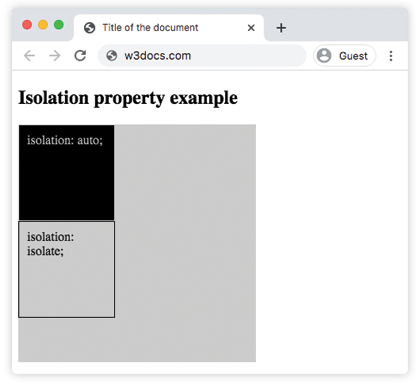
Beispiel für die isolation-Eigenschaft in Kombination mit der mix-blend-mode-Eigenschaft:
Weiteres CSS-Codebeispiel für isolation
html
<!DOCTYPE html>
<html>
  <head>
    <title>Title of the document</title>
    <style>
      * {
        box-sizing: border-box;
      }
      body {
        background-color: #eee;
        color: #555;
        font-size: 1.1em;
        font-family: Roboto, Helvetica, Arial, sans-serif;
      }
      .isolation-example {
        margin: 1em auto;
        width: 100%;
        max-width: 814px;
        position: relative;
      }
      img {
        width: 100%;
      }
      .isolation-example h1 {
        position: absolute;
        top: 5em;
        color: white;
        text-align: center;
        font-size: 40px;
        width: 100%;
        text-transform: uppercase;
        background-color: #000;
        padding: .5em .25em;
        mix-blend-mode: overlay;
        isolation: isolate;
      }
    </style>
  </head>
  <body>
    <h2>Isolation property example</h2>
    <div class="isolation-example">
      <img src="https://de.w3docs.com/uploads/media/default/0001/01/4982c4f43023330a662b9baed5a407e391ae6161.jpeg" alt="Yellow tree." />
      <div class="element">
        <h1>House</h1>
      </div>
    </div>
  </body>
</html>Werte
| Value | Description |
|---|---|
| auto | Es wird kein neuer Stapelkontext erstellt, es sei denn, andere Eigenschaften (wie mix-blend-mode oder filter) erfordern einen. Dies ist der Standardwert. |
| isolate | Erstellt einen Stapelkontext für ein Element und isoliert die Gruppe. |
| initial | Legt fest, dass die Eigenschaft ihren Standardwert verwendet. |
| inherit | Erbt die Eigenschaft vom Elternelement. |
Praxis
Was bewirkt die 'isolation'-Eigenschaft in CSS?